

Best Places to Move in North Carolina: A Regional Guide
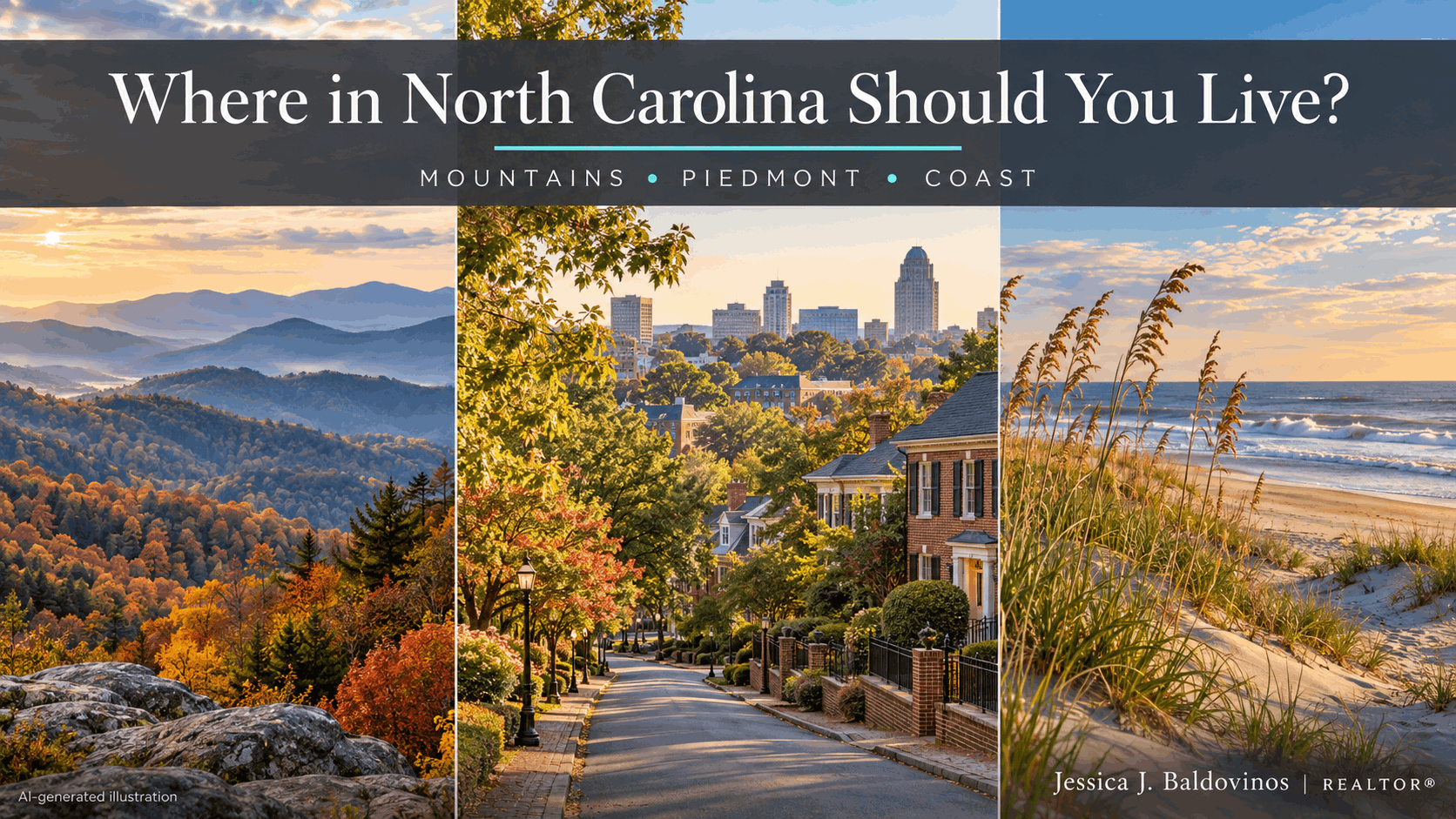
What Part of North Carolina Is Best to Move To? Mountains, Piedmont, and Coast Compared
Imagine starting your morning with coffee overlooking the Blue Ridge Mountains, spending an afternoon exploring a lively downtown, or ending your day with your feet in the sand. In North Carolina, each of those experiences can be part of the life you choose to build.
What I love about this state is the variety. You can search for a home near mountain trails, a city with a broad employment market, a smaller community surrounded by farmland, or a place close to the Atlantic Ocean. You can pursue more space, a different pace, a new career, or a home that better fits the next chapter of your life.
The question is not simply whether North Carolina is a good place to move. It is which part of North Carolina fits you best?
I’m Jessica J. Baldovinos, REALTOR® with Real Broker, and I personally serve the Triad and Triangle areas, including Burlington, Alamance County, and surrounding communities. I also have real estate connections throughout North Carolina, so if your search leads to the mountains, coast, Charlotte, or another area, you can still start with me. I can help connect you with an agent who serves your destination.
And that first conversation does not have to stop at the state line. Whether you are moving to North Carolina, leaving it, or exploring a move elsewhere, reach out. I can help you find an agent connection for the place you want to call home.
Your housing budget, income, commute, healthcare needs, climate preferences, and willingness to maintain a property all matter. So do ordinary expenses: filling your gas tank, buying groceries, paying utilities, and insuring your home.
For someone seeking a balance of housing affordability, employment access, and everyday convenience, I would begin with the Piedmont—especially the Triad. The mountains deserve consideration if outdoor recreation and cooler elevations lead your priorities. The coast may be the right choice if water access is central to your lifestyle and your budget accounts for insurance, weather exposure, and maintenance.
That is a practical starting point, not a statewide ranking. Let’s compare what living in each region actually requires.
North Carolina’s Three Regions at a Glance
North Carolina is commonly divided into the Mountains, Piedmont, and Coast. The eastern region includes the Inner Coastal Plain as well as beach communities, so “eastern North Carolina” does not necessarily mean living near the ocean. Visit North Carolina describes these three regions and their distinct landscapes.
| Region | Places to explore | Main appeal | Costs and practical issues to investigate |
|---|---|---|---|
| Mountains and western foothills | Asheville, Hendersonville, Boone, Brevard, Waynesville; foothill options around Morganton and Lenoir | Mountain scenery, trails, outdoor recreation, smaller towns | Housing premiums in popular destinations, steep access, winter conditions, drainage, repair history, internet availability |
| Piedmont | Greensboro, High Point, Winston-Salem, Burlington, Raleigh, Durham, Charlotte, and surrounding towns | City amenities, different employment markets, suburban and rural choices | Housing varies substantially between metros; commuting, growth, taxes, and infrastructure affect daily costs |
| Coast and Coastal Plain | Wilmington, New Bern, Jacksonville, Morehead City, coastal Brunswick County, Outer Banks; inland options such as Greenville and Goldsboro | Beaches, rivers, boating, historic towns, and inland eastern communities | Flood and wind coverage, storm preparation, humidity, salt exposure, seasonal traffic, and distance to services |
 1. Moving to the North Carolina Mountains
What makes mountain living appealing?
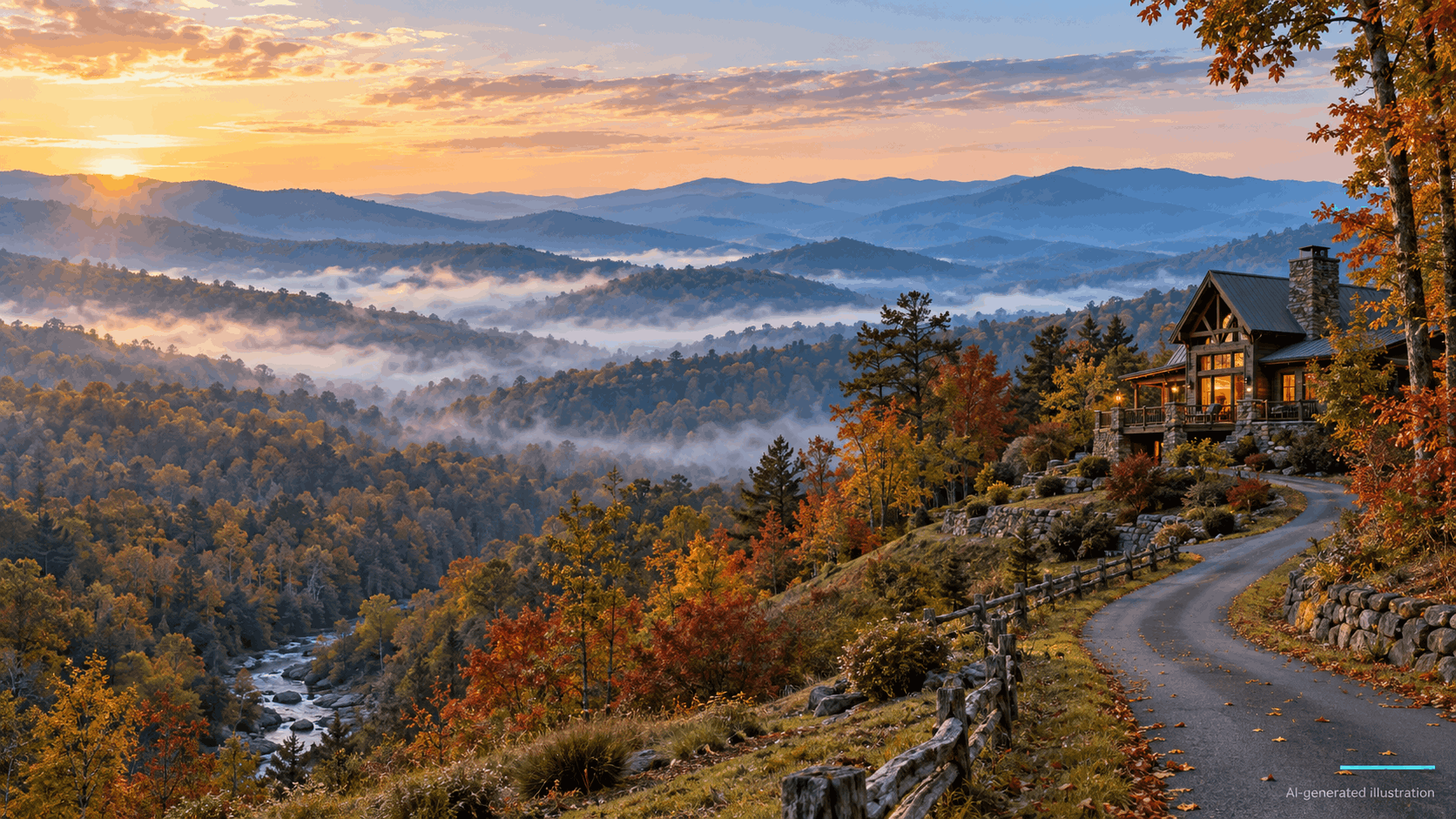
If your ideal weekend begins with a trail rather than a traffic light, the mountains may feel like an invitation to live differently. Picture fall color outside your window, a porch where you actually want to spend time, and outdoor adventures that become part of your routine rather than something you save for one vacation each year.
Western North Carolina appeals to people who want forests, scenic drives, hiking, waterfalls, and access to outdoor recreation. Higher elevations can offer relief from summer heat, although temperatures vary with elevation and location. A valley town and a home on a high ridge can have very different weather and access conditions.
The region also offers different styles of daily life. Asheville is worth researching if you want an urban base in the mountains. Hendersonville, Waynesville, and Brevard offer smaller-town alternatives. Boone and nearby High Country communities are worth exploring if access to higher-elevation recreation matters to you. Foothill communities can offer another compromise between mountain access and daily driving convenience.
Treat these as places to investigate, not interchangeable options. A home close to a downtown grocery store creates a different routine from a secluded home reached by a steep private road.
Is living in the mountains affordable?
Do not assume a smaller mountain town means inexpensive housing. Views, vacation demand, limited buildable land, and the desirability of a specific location can affect what buyers pay.
For context, Zillow’s Asheville home-value page reported a typical home value of $448,688 as of August 31, 2026. That is a modeled housing-market benchmark, not a starting price for every home and not a regional average for western North Carolina.
Look beyond the purchase price. A lower-priced mountain property may require substantial spending on a driveway, retaining wall, drainage, roof, heating system, or well and septic system. Ask who maintains the road and whether emergency vehicles can reach the property in difficult weather.
What about jobs and income?
Your employment plan should come before your property search. Check actual openings, pay, benefits, and commute routes in your field. Tourism-related work and an established year-round professional role can produce very different household budgets.
The North Carolina Department of Commerce’s regional projections anticipate employment growth across the state, but at different rates. Its western projections also account for longer-term recovery from Hurricane Helene. A projection is useful context; it is not a promise of an available job.
Remote workers should verify service at the exact property address. Ask for available internet plans and speeds, test mobile reception, and consider backup power. “Internet available in the area” is not enough to establish that a particular home supports reliable video calls.
What should buyers investigate in the mountains?
Review the property’s flood exposure, drainage, slope stability, road access, repair history, and any prior storm damage. Ask for permits and documentation for completed repairs. Hurricane impacts are not confined to the coast, and mountain scenery does not eliminate flood risk.
For rural properties, investigate well water, septic capacity, easements, road-maintenance agreements, and travel time to medical care. Measure drive time rather than relying on mileage: a short distance along winding roads can take longer than expected.
My recommendation: Explore the mountains if you will use and enjoy the outdoor setting regularly, and your income and property-maintenance budget support the location you choose.
 2. Moving to the Piedmont
Why is the Piedmont a strong starting point?
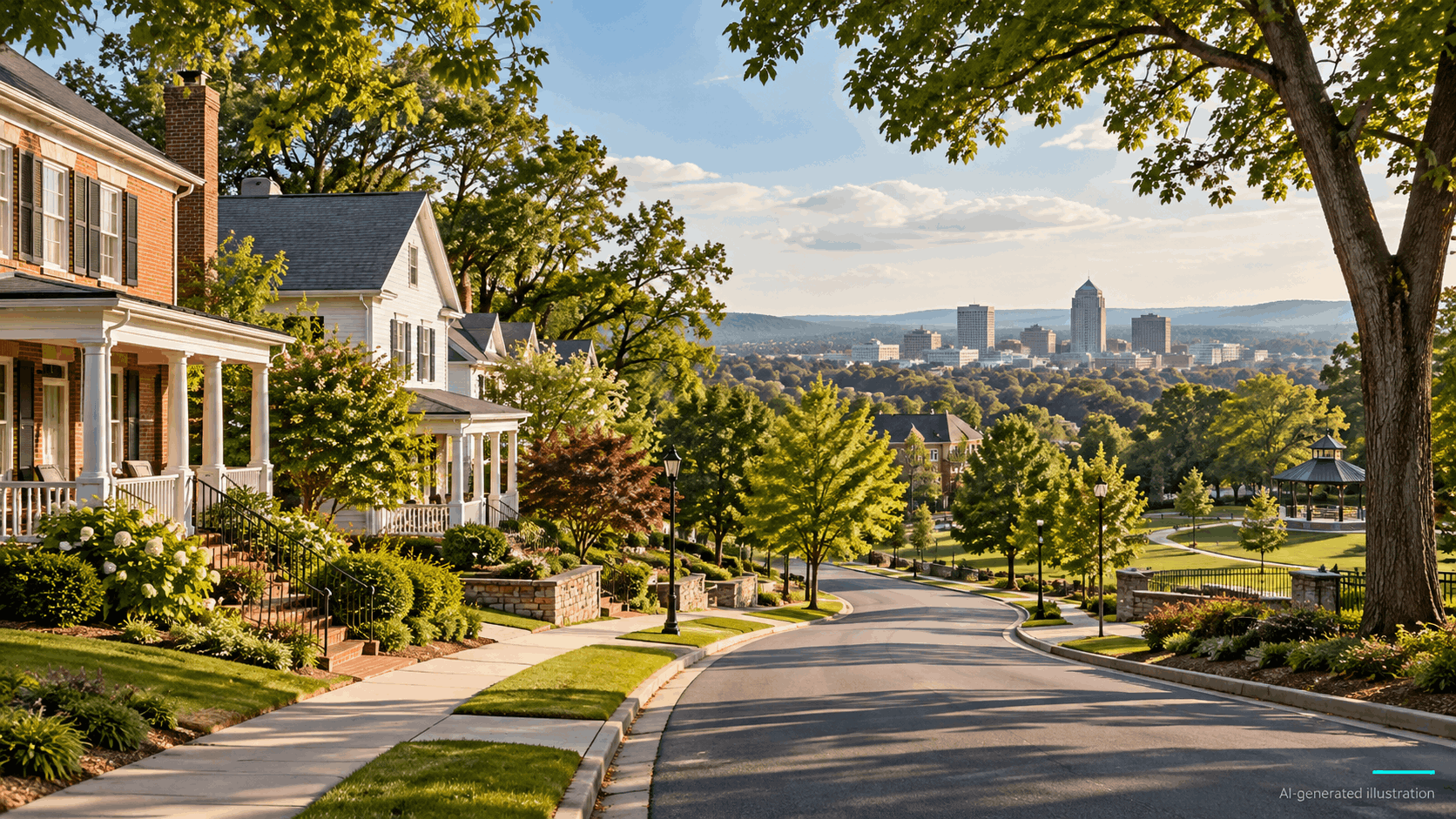
The Piedmont offers room to build a life with variety: a downtown dinner one evening, a park or greenway the next morning, and a home search that can include established neighborhoods, newer communities, and properties with more land. For many buyers, that flexibility is the appeal.
It is also where I personally work with buyers and sellers across the Triad and Triangle. If you are still deciding between these areas, we can begin with your priorities and narrow the search around the life you want—not just the photos that catch your attention online.
The Piedmont offers a wide range of choices, from major metropolitan areas to smaller cities and rural communities. It can make sense for buyers who want access to employment, shopping, medical services, and recreation without making mountain or beachfront living their primary goal.
But “the Piedmont” is too broad to use as a single housing market. The Triad, Triangle, and Charlotte area deserve separate comparisons.
The Triad: Greensboro, High Point, and Winston-Salem
The Triad is worth a closer look if you want choices without committing to one type of lifestyle. Your search might begin with a home near downtown activities, a neighborhood with an established canopy of trees, a newer home with less immediate updating, or a property outside town with room for a garden. Available options depend on your budget and the current market, but there is more to explore than one city or one subdivision.
For buyers focused on balancing their housing budget with everyday convenience, I would put the Triad near the top of the research list.
As of August 31, 2026, Zillow reported typical home values of $263,264 in Greensboro and $263,057 in Winston-Salem. Both were below the Asheville and Wilmington benchmarks in this guide. These figures do not guarantee availability at a particular price, and they say nothing by themselves about the condition of an individual home. Sources: Greensboro and Winston-Salem.
Explore Greensboro, High Point, and Winston-Salem alongside places such as Kernersville, Jamestown, Thomasville, and other surrounding communities. Compare the actual trip to your workplace, preferred shopping, and medical providers. A home between cities can be convenient for one household and create too much driving for another.
Burlington and Alamance County
If you are drawn to a smaller-city setting while keeping the Triad and Triangle on your radar, Burlington and Alamance County deserve a visit. Explore Burlington, Graham, Mebane, and surrounding communities with your actual routine in mind. Spend time in their downtown areas, drive the routes you would use, and imagine where your regular errands and weekend plans would take you.
Burlington and surrounding Alamance County communities are worth investigating if you want options along the corridor between the Triad and Triangle.
The key question is where you need to travel most often. A buyer commuting toward Greensboro has a different search than someone driving toward Durham. Test the commute at the time you would actually leave for work, and include fuel, vehicle wear, and the value of your time in the comparison.
Explore existing homes, new construction, and more rural properties separately. Public utilities, private well and septic systems, HOA obligations, and lot maintenance can change the cost of owning two otherwise similar homes.
The Triangle: Raleigh, Durham, and Chapel Hill
For someone excited by learning, professional growth, restaurants, cultural activities, and access to major universities, the Triangle can be especially compelling. You can explore Raleigh, Durham, Chapel Hill, and surrounding communities such as Cary, Apex, and Hillsborough, then compare the daily experience each location offers.
The Triangle deserves consideration when your employment or education needs connect you to its universities, research institutions, healthcare systems, and technology or life-science economy. North Carolina’s key-industry overview highlights research, biotechnology, pharmaceuticals, and information technology as major state sectors.
Housing costs need careful attention. Zillow’s August 2026 Raleigh page reported a $428,671 typical home-value benchmark, but the page also warned that its displayed data represented the surrounding area because specific location data was unavailable. Use that number as broad context, not a precise city-only comparison. Source: Zillow.
Before choosing an outer suburb to save money, calculate the transportation tradeoff. A lower mortgage payment can lose some of its advantage if it creates a long daily commute or requires another vehicle.
Charlotte and surrounding communities
Charlotte is another area to research if your priorities include a larger metropolitan setting and access to business and financial services. North Carolina Commerce identifies business and financial services as a major state industry.
Compare the neighborhood and commute rather than choosing on the city name alone. A downtown residence, suburban development, and rural property outside the metro offer different daily routines. Verify transit access if you plan to depend on it, and compare current local housing options before making assumptions about affordability.
The Piedmont’s tradeoffs
Central North Carolina can bring hot, humid summers, traffic on major routes, and substantial differences between older neighborhoods, new developments, and rural areas. Severe weather and flooding also remain property-specific concerns.
My recommendation: Start with the Triad if housing value is a major priority. Expand toward the Triangle or Charlotte when your job, income, or preferred amenities justify the housing and transportation costs.
 3. Moving to the Coast and Eastern North Carolina
Beach living and eastern North Carolina are different choices
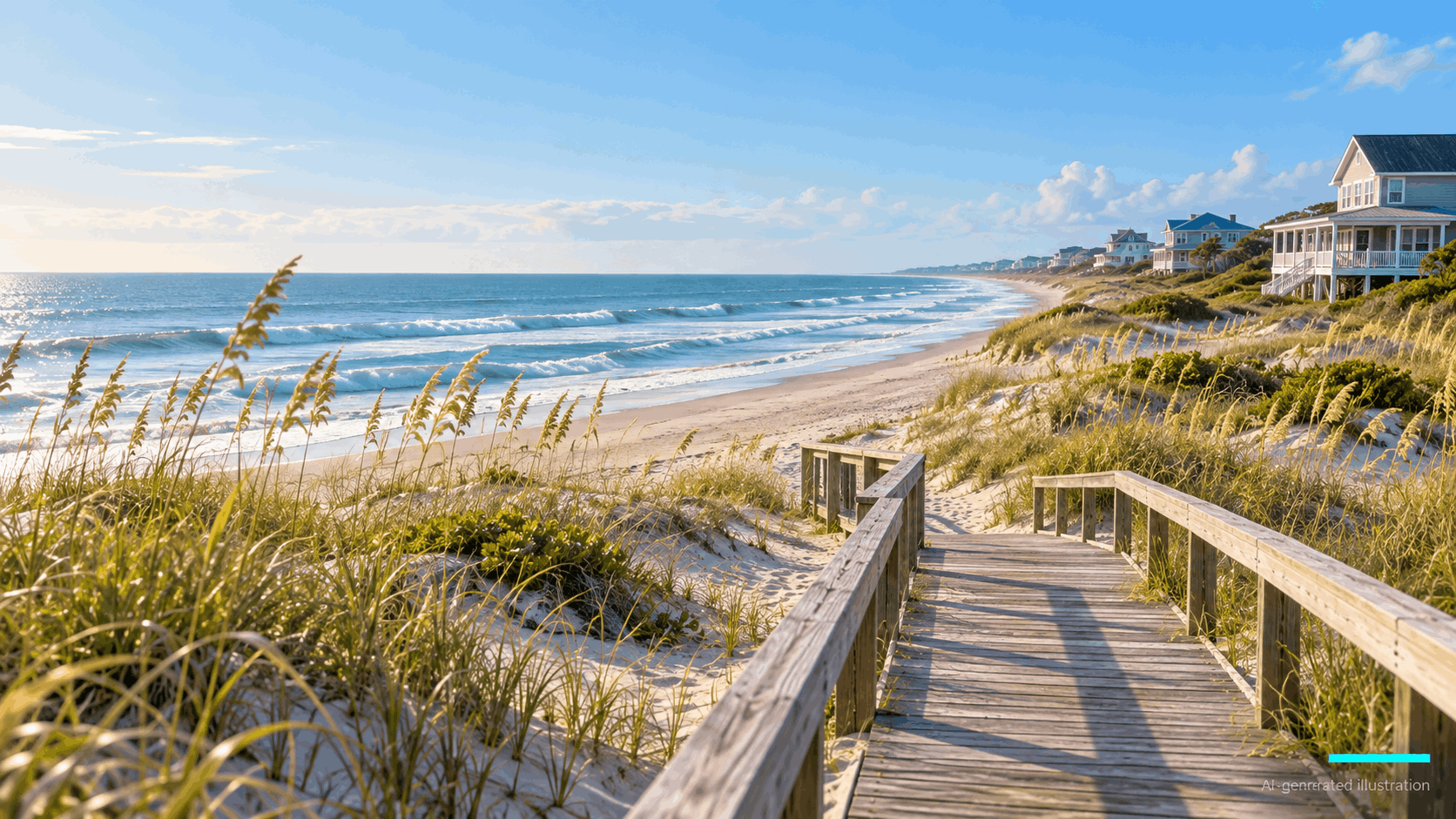
If you find yourself counting down the days until your next beach trip, moving east may turn a favorite escape into part of everyday life. There is something appealing about planning your week around time on the water, an evening walk, or a slower morning near the shore. The best version of that dream is one you can comfortably sustain all year.
An oceanfront home, an inland Wilmington neighborhood, a riverfront property in New Bern, and a home in Greenville should not share one relocation budget.
Decide what “coastal living” means to you. Do you need to walk to the beach, keep a boat nearby, live near a river, or simply be within driving distance of occasional beach trips? Each answer creates a different search.
Wilmington and nearby coastal communities
Wilmington is worth exploring if you want a city base with access to the coast. Zillow reported a typical Wilmington home value of $419,038 as of August 31, 2026. This is a city housing benchmark, not an oceanfront-home price or an average for every surrounding beach community. Source: Zillow.
If you are comparing Wilmington, nearby mainland communities, and beach towns, investigate insurance and maintenance costs for each specific property before deciding which is more affordable.
New Bern, Jacksonville, and inland eastern options
New Bern and Jacksonville offer other eastern communities to investigate. Greenville and Goldsboro are examples of inland Coastal Plain options; they should not be described as beachfront destinations.
An inland location may let you include beach trips in your lifestyle without buying a beach property. However, inland does not automatically mean low risk or low cost. Check river flooding, drainage, employment access, and the actual travel time to the services you need.
Outer Banks and other beach communities
If your goal is to live on or near a barrier island, investigate year-round life before buying. Visit outside peak vacation season. Check grocery access, medical care, evacuation routes, storm preparation, and whether nearby rentals change traffic and activity during tourist season.
Do not build an ownership budget around assumed vacation-rental income. Verify local rules, association restrictions, insurance requirements, management expenses, and realistic occupancy before treating rent as dependable income.
Insurance and maintenance can change the whole budget
The North Carolina Department of Insurance explains that standard homeowners policies generally exclude flood damage and may exclude windstorm or hail coverage. Buyers should ask an insurance professional which policies, endorsements, and deductibles apply to the exact home.
Get quotes before committing to a property. Include homeowners coverage, any separate wind or flood coverage, and association obligations. Salt exposure, humidity, and weather can also affect maintenance needs for exterior materials, mechanical equipment, and metal components.
My recommendation: Choose the coast when water access will meaningfully improve your everyday life and you can comfortably fund the total ownership cost—not just the mortgage payment.
What Does It Cost to Live in North Carolina?
Housing: a useful starting comparison
| Location | Typical home-value benchmark | Data date |
|---|---|---|
| Asheville | $448,688 | August 31, 2026 |
| Greensboro | $263,264 | August 31, 2026 |
| Winston-Salem | $263,057 | August 31, 2026 |
| Raleigh/surrounding-area figure* | $428,671 | August 31, 2026 |
| Wilmington | $419,038 | August 31, 2026 |
Source: the Zillow pages linked above. These are Zillow Home Value Index benchmarks, not median listing prices, individual appraisals, or guaranteed purchase prices. *Raleigh’s source includes a surrounding-area data warning. Figures represent selected markets, not averages for the three regions.
For renters, compare the same bedroom count and property type in each location. Include utilities, parking, pet fees, deposits, and transportation. A broad average rent can conceal substantial differences between an apartment, a detached house, and a seasonal rental.
Gas prices: the commute matters as much as the pump
The AAA page retrieved for this guide displayed the following October 10, 2026 regular-gasoline averages, rounded to the nearest cent. Prices change daily, and a metro average is not a quote from every station. Source: AAA.
| Area | Regular gasoline per gallon |
|---|---|
| North Carolina statewide | $4.07 |
| Asheville | $4.09 |
| Greensboro | $4.09 |
| Burlington | $4.04 |
| Raleigh | $4.11 |
| Durham–Chapel Hill | $4.15 |
| Charlotte–Gastonia–Rock Hill, NC portion | $4.08 |
| Wilmington | $4.02 |
An illustrative calculation: driving 1,000 miles monthly in a vehicle getting 25 miles per gallon uses 40 gallons. At $4.07 per gallon, fuel would cost approximately $162.80 monthly. At 1,500 miles, it would be about $244.20. These examples exclude repairs, insurance, registration, and vehicle payments.
A slightly cheaper gas price does not necessarily make a location cheaper overall. Compare how much driving the address requires.
Milk and groceries: what benchmark should you use?
The Bureau of Labor Statistics series published through the Federal Reserve Bank of St. Louis reported $4.229—about $4.23—for a gallon of fresh, fortified whole milk in August 2026. This is a U.S. city-average benchmark, not a North Carolina price or a separate mountain, Piedmont, or coastal average. Source: FRED/BLS.
At that benchmark, four gallons would cost about $16.92 before any applicable checkout tax. Your actual store price depends on location, brand, milk type, package size, and promotions. Organic and specialty products should be compared separately.
For a realistic relocation comparison, price the same shopping basket at stores near each candidate home: a gallon of milk, a dozen eggs, bread, rice, chicken, produce, coffee, and household supplies. Compare unit prices and include the trip to the store. This is more useful than assuming one entire region has cheaper groceries.
North Carolina applies a 2% local sales tax to qualifying food. Prepared foods, candy, soft drinks, and other excluded categories follow different tax treatment. Source: NCDOR.
Taxes, utilities, and insurance
North Carolina’s individual income-tax rate for 2026 is 3.99% of North Carolina taxable income. That does not mean 3.99% of everyone’s gross pay; deductions and other tax rules affect taxable income. Source: NCDOR.
General combined sales-tax rates vary by county. Examples in the current NCDOR table include 6.75% in Guilford and Alamance, 7% in Forsyth, Buncombe, and New Hanover, 7.25% in Wake, 7.5% in Durham and Orange, and 8.25% in Mecklenburg. These general rates do not replace the qualifying-food rate or describe every specially taxed purchase. Source: NCDOR.
Property taxes require an address-specific comparison. Check county and municipal taxes, any applicable district charges, and the property’s assessed value. Ask for the prior tax bill, then verify how a purchase or revaluation could affect your future bill.
For utilities, request available historical usage and bills. The home’s size, insulation, heating fuel, equipment, and occupancy matter. Rural ownership may also include well, septic, private-road, or propane expenses that do not appear on an ordinary city utility bill.
Insurance deserves its own budget line in every region. The state’s homeowners base-rate settlement included average statewide increases of 7.5% effective June 1, 2025, and another 7.5% effective June 1, 2026, with differences by territory. Those figures do not predict the increase on an individual policy. Source: NC Department of Insurance.
Which Region Should You Research First?
| Your leading priority | A practical starting point | What to confirm |
|---|---|---|
| Housing value with city conveniences | Triad and surrounding Piedmont communities | Available homes, condition, total payment, commute |
| A job tied to a major professional market | Triangle or Charlotte area | Actual employment offer, take-home income, housing and transportation costs |
| Hiking, scenery, and higher-elevation recreation | Mountains or foothills | Access, weather, internet, maintenance, income plan |
| Beach or boating access | Coastal communities | Insurance, flood and wind exposure, year-round services |
| More land or fewer nearby homes | Rural options in any region | Utilities, septic, access rights, zoning, travel time |
| Retirement | Any region that supports your daily needs | Healthcare access, home accessibility, maintenance, fixed-income budget |
These recommendations reflect practical tradeoffs, not guaranteed outcomes. A specific home and commute can matter more than the regional label.
Before You Move: Test the Life You Plan to Live
Visit your finalists on an ordinary weekday. Drive the work route, shop for groceries, locate medical providers, and spend time in the area at different hours. If school assignments matter to your household, verify the exact address with the district and review current programs yourself.
Build one complete monthly budget for each location. Include housing, taxes, insurance, utilities, transportation, groceries, childcare where applicable, association fees, maintenance, and savings. For buyers, keep closing costs, inspections, moving expenses, and an emergency reserve separate from the down payment.
Then ask yourself: Will I use what I am paying extra to live near? A mountain view, beach access, or downtown location can be worth the cost when it improves your daily life. If you will rarely use it, another location may support your goals better.
So, What Part of North Carolina Is Best to Move To?
For a balanced starting point, I recommend researching the Piedmont, especially the Triad. The selected housing benchmarks show why Greensboro and Winston-Salem deserve attention when affordability is a priority. Burlington, Alamance County, and surrounding communities add other options to compare based on your work and lifestyle.
The mountains can be the better choice when outdoor living is central to your plans. The coast can be the better choice when water access is worth the additional property-specific expenses. The Triangle or Charlotte may make more sense when your career and income connect you to those markets.
The right move starts with matching the place to your actual budget and daily routine.
Your Move Can Start With One Conversation
You do not need to have the city, neighborhood, or house picked out before reaching out. You can start with a question: “Where would my budget go further?” “Which area works with my job?” “Can I find more land?” Or simply, “I’m ready for a change—where do I begin?”
I personally serve buyers and sellers in the Triad and Triangle areas of North Carolina, including Greensboro, High Point, Winston-Salem, Burlington, Alamance County, Raleigh, Durham, and surrounding communities. We can begin by discussing what matters to you, then compare locations and next steps based on your budget and timeline.
Looking elsewhere in North Carolina? I have connections across the state. If the mountains, coast, Charlotte area, or another community becomes your destination, I can help connect you with an agent who knows that local market.
Moving beyond North Carolina? You can still make me your first contact. Tell me where you are headed, and I can help you find an agent connection for your destination. Whether you are buying, selling, relocating for work, or planning a new chapter, you do not have to begin the search for professional guidance alone.
Start with a 15-minute introductory conversation. We will discuss where you are now, where you hope to go, and what you need from your next move.
Your next chapter could begin in North Carolina. Wherever it takes you, let’s start the conversation.
Connect with Jessica J. Baldovinos, REALTOR® | Real Broker
📍 Personally serving the Triad & Triangle, including Burlington & Alamance County and surrounding NC communities. Agent connections throughout North Carolina and help finding an agent wherever your move takes you.

Categories
- All Blogs (676)
- "Did You Know?" (12)
- Best Places to Live (2)
- Buying/Selling Raw Land (48)
- Distressed/Foreclosure Education (61)
- Divorce in NC? Own Real Estate? You Should Know... (57)
- First Time Home Buyer Education (87)
- For Aspiring Agents (20)
- For NC Wholesalers (33)
- For Real Estate Agents (55)
- FSBO Tips (92)
- Holiday Moves (6)
- Homebuyer Tips (114)
- Homeowner Tips (116)
- Homesteaders (10)
- Keeping it Real (24)
- Market Forecast (22)
- Market Updates and Trends (109)
- Moving to North Carolina (7)
- My Story (3)
- NC Luxury Market Data (45)
- NC Probate (3)
- New Construction Homes (33)
- Psychology of Real Estate (6)
- Real Estate Investor Education (139)
- Sociology and Real Estate (5)
- STOP Renting! START Owning! (66)
- Win PRIZES! (1)
Recent Posts








GET MORE INFORMATION

REALTOR® NCREA CREIPS License ID: 312309