
Buying a House in NC With Less-Than-Perfect Credit
by Jessica J Baldovinos
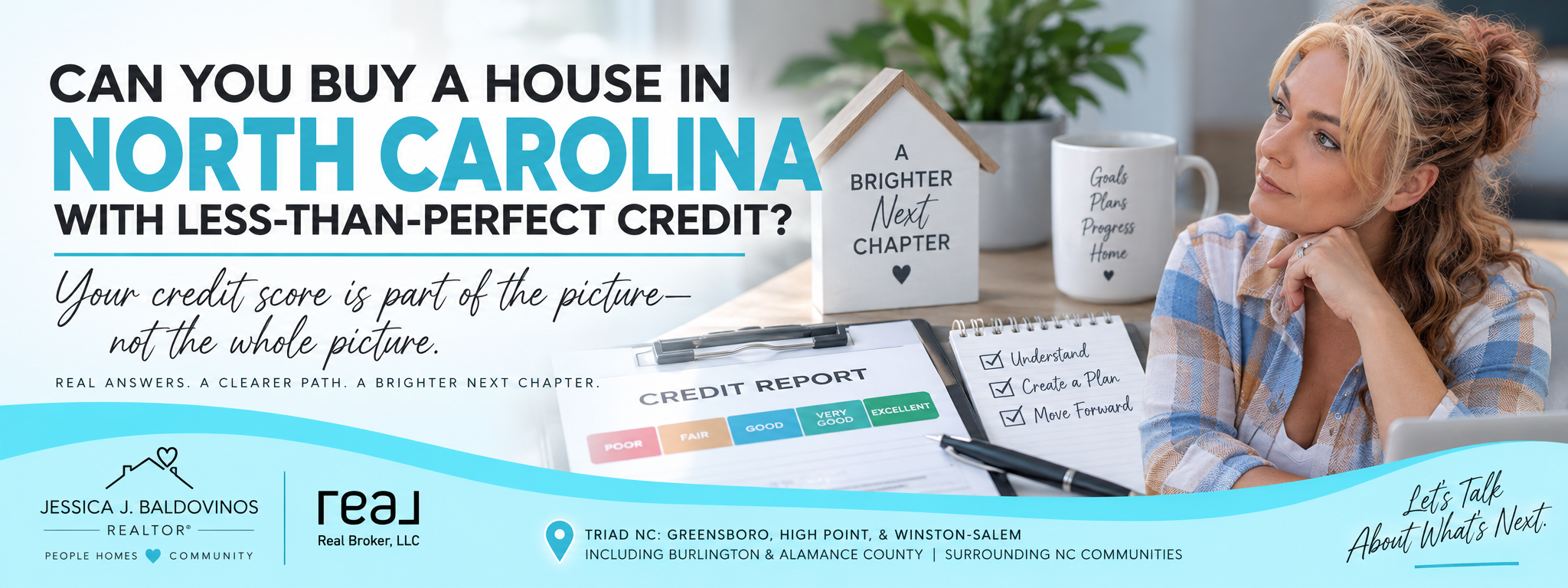
Can You Buy a House in North Carolina With Less-Than-Perfect Credit?
You may be able to buy a house in North Carolina with less-than-perfect credit, depending on your loan program, finances, and lender requirements.
If you've been telling yourself:
“I need to fix my credit before I talk to a REALTOR® or lender.”
I want you to reconsider that.
You may need to improve your credit before buying a home.
You may need several months to prepare.
You may discover something on your credit report that needs attention.
But you may also be closer to homeownership than you think.
The important thing is this: don't disqualify yourself based on a credit score you saw in an app, something that happened financially years ago, or advice from somebody on social media.
Your credit matters when buying a home—but your credit score is not the only thing a mortgage lender evaluates.
Let's talk about what that actually means.
There Is No One Universal “Homebuying Credit Score”
One of the most common questions prospective buyers ask is:
“What credit score do I need to buy a house in North Carolina?”
It sounds like there should be one simple number.
There isn't.
Mortgage eligibility depends on the loan program, lender requirements, your complete financial profile, and other underwriting factors.
Your credit score can affect your ability to qualify as well as the interest rate or loan terms you're offered. But lenders may also consider your income, existing debts, assets, savings, and information contained in your credit history.
So when someone tells you:
“You need a ___ credit score to buy a house.”
That's an oversimplification.
The better question is:
“Given my entire financial situation, what mortgage options might I qualify for—and what could I improve?”
 The Credit Score You See May Not Be the Score Your Mortgage Lender Uses
This surprises a lot of buyers.
You don't actually have just one credit score.
Different scoring models can produce different scores using information from your credit reports.
That means the number you see through a credit card company, banking app, or consumer credit service may not be identical to the score used during mortgage qualification.
That's another reason I don't want buyers panicking over a number on their phone.
It's useful information, but it isn't necessarily the entire story.
A mortgage professional can evaluate the information relevant to the financing you're actually trying to obtain.
Can Someone With a Lower Credit Score Get a Mortgage?
Potentially, yes.
Different mortgage programs have different guidelines, and individual lenders may have additional requirements.
FHA financing, for example, may provide possibilities for some borrowers with lower credit scores. Other financing programs have their own eligibility and underwriting requirements.
But this is important:
A minimum credit-score guideline does not mean someone with that score is automatically approved.
Your entire financial picture still matters.
That's why I don't believe a social media post, online calculator, or one credit number should be used to diagnose whether you can buy a home.
Your Debt Matters Too
Here's another reason focusing exclusively on your credit score can be misleading.
A lender also needs to understand your existing financial obligations relative to your qualifying income.
You'll often hear this discussed as your debt-to-income ratio, or DTI.
Generally, your DTI compares applicable monthly debt obligations—including your proposed housing payment—with qualifying monthly income.
The actual underwriting requirements depend on the mortgage program, lender, and individual circumstances.
This means two people with the exact same credit score could have very different mortgage situations.
One may have significant monthly debt.
Another may have very little.
One may have substantial savings and reserves.
Another may not.
One may have qualifying income that comfortably supports the proposed housing payment.
Another may need to reduce debt or reconsider the target price range.
A credit score by itself can't tell us all of that.
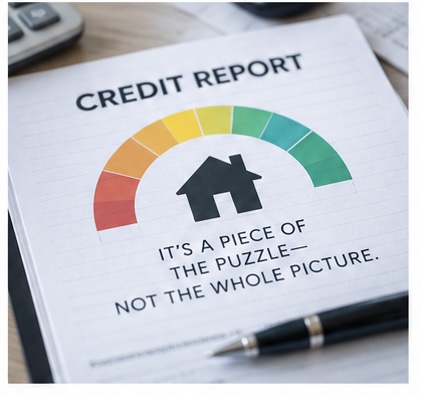 Before You Start “Fixing” Your Credit, Find Out What Actually Needs Fixing
This is one of the biggest mistakes I want prospective buyers to avoid.
Someone decides:
“I'm buying a house next year, so I need to fix my credit.”
Then they start making financial moves without knowing how those decisions could affect mortgage qualification.
They might:
- close an older credit card
- open a new credit account
- finance a vehicle
- move balances around
- make a major purchase
- pay accounts in a particular order
- hire a company promising a quick credit fix
Some financial decisions may help.
Others may not accomplish what you think they will.
Don't make random financial moves based on random internet advice.
If homeownership is the goal, get information relevant to your financial situation and create a strategy around that goal.
Check Your Credit Reports for Errors
This is something you can do before you're ready to buy.
Review your credit reports carefully.
Look for information that doesn't belong to you, incorrect account information, inaccurate balances, or other potential errors.
Why?
Because inaccurate negative information can potentially affect your credit profile.
And remember:
Your credit report and your credit score are not the same thing.
Your credit reports contain information about your credit history. Credit-scoring models use information from those reports to calculate scores.
Checking your own credit reports also does not hurt your credit score.
What If You Have Collections?
Don't immediately assume a collection means homeownership is impossible.
But don't assume you should simply pay every collection account tomorrow, either.
How a collection affects mortgage qualification can depend on the account, loan program, lender requirements, and your overall financial circumstances.
This is exactly where personalized guidance matters.
Instead of asking social media:
“Should I pay this collection?”
show your actual financial and credit information to a qualified mortgage professional and ask:
“What should I address first if my goal is to qualify for a mortgage?”
Now you have a strategy instead of a guess.
What If You've Had a Bankruptcy or Foreclosure?
Past financial hardship doesn't necessarily mean you'll never own a home.
Certain mortgage programs have waiting periods and eligibility requirements following events such as bankruptcy or foreclosure.
The details can depend on the type of event, mortgage program, timing, circumstances, and lender requirements.
So if something significant happened in your financial past, don't avoid the conversation because you assume the answer will be no.
Find out what the timeline actually is.
If you're not eligible today, knowing why and knowing when that could potentially change gives you something valuable:
a plan.
Don't Buy the Car Before the House Without Talking to Your Lender
Please remember this one.
You're preparing to buy a house.
Your car starts getting old.
You see the shiny SUV.
The payment looks manageable.
You finance it.
Now you've added another monthly debt obligation immediately before trying to qualify for a mortgage.
That new payment can affect your debt-to-income ratio, while applying for additional credit may also affect your credit profile.
I'm not saying:
“Never buy a car.”
I'm saying:
If buying a home is one of your immediate goals, talk to your mortgage professional before taking on significant new debt.
The same principle applies to furniture, credit cards, personal loans, and other major financed purchases.
And this doesn't stop once you're preapproved.
Your financial situation still matters between preapproval and closing.
Don't assume you're safe to finance the new living-room furniture just because you've already found the house.
 What If You're About 3 Months Away From Buying?
Now is a good time to get specific.
You should be learning:
- what your credit profile looks like
- what mortgage options may be available to you
- approximately how much cash you may need
- what monthly housing payment feels comfortable to you
- whether anything needs to change before applying
- what documentation you'll eventually need
This isn't the time for random financial experimentation.
It's time for a plan.
What If You're About 6 Months Away?
Excellent.
Six months gives you time to learn and prepare.
If your credit needs improvement, a mortgage professional or qualified housing counselor may be able to help identify areas that deserve attention.
You can also work on savings, spending, debt, and your overall homebuying budget.
Then, when you're ready to begin looking at homes, you'll understand far more than someone who waited until the week they wanted to buy.
What If You're a Year or More Away?
Talk to us anyway.
Seriously.
You do not have to be preapproved tomorrow for an initial conversation to be worthwhile.
If homeownership is a goal for next year—or even beyond that—learning what you'll eventually need gives you time to make intentional decisions.
Maybe your plan becomes:
Improve credit → Reduce debt → Build savings → Obtain preapproval → Begin the home search
Great.
Now instead of saying:
“Someday I want to buy a house…”
you have milestones.
 What If You're Ready Right Now and Just Don't Know It?
This happens too.
Someone has spent months—or even years—assuming they aren't ready because:
“My credit isn't perfect.”
“I still have a car payment.”
“I don't have 20% down.”
“I had financial problems before.”
“I've never bought a house.”
None of those statements, by themselves, tells me whether you can qualify for a mortgage today.
That's why I don't want you self-disqualifying.
Get the facts first.
Then make the decision.
A REALTOR® and Mortgage Lender Have Different Jobs
This distinction matters.
As your REALTOR®, my role is not to determine whether you qualify for a particular mortgage.
That's the lender's job.
My role is to help you understand the homebuying process, connect you with appropriate resources when needed, prepare you for what comes next, represent your interests during the real estate transaction, and help you make informed decisions about the property and your offer.
That's also why I want financing conversations happening before we start touring homes.
Finding the perfect house and then figuring out whether you can finance it is backwards.
Let's understand your purchasing position first.
Then let's shop intelligently.
 So, Can You Buy a House in North Carolina With Less-Than-Perfect Credit?
Possibly.
There is no responsible way for me—or anyone else—to answer that question for you based solely on one number.
Your credit matters.
Your debt matters.
Your income matters.
Your assets and savings can matter.
Your chosen mortgage program matters.
Your overall financial picture matters.
And the requirements of the lender underwriting your mortgage matter.
What you shouldn't do is decide the answer is “no” without ever asking.
 Buying a Home in the Triad or Burlington, North Carolina?
I'm Jessica J. Baldovinos, REALTOR® and Certified Mentor with Real Broker, LLC, helping North Carolina buyers understand the homebuying process before they're standing inside a house wondering what happens next.
You don't have to contact me and say:
“I'm ready to buy.”
You can say:
“I want to buy eventually, but I don't know where I stand.”
That's enough to begin.
📍 Triad NC: Greensboro, High Point, & Winston-Salem | Including Burlington & Alamance County | Surrounding NC communities
Let's Figure Out Your Starting Point
Whether you're ready now, six months away, a year away, or simply trying to understand what needs to happen first, education is part of the process.
You don't need to have everything figured out before you start asking questions.
That's what the conversation is for.
📲 Jessica J. Baldovinos, REALTOR®
Certified Mentor | Real Broker, LLC
NCREL #312309
(336) 567-5843
JessicaJBRealtor.net
@JessicaJBRealtor
Educational information only. Mortgage programs, credit requirements, underwriting standards, and lender requirements vary and may change. Consult a qualified mortgage professional regarding your individual financing circumstances.
Categories
- All Blogs (676)
- "Did You Know?" (12)
- Best Places to Live (2)
- Buying/Selling Raw Land (48)
- Distressed/Foreclosure Education (61)
- Divorce in NC? Own Real Estate? You Should Know... (57)
- First Time Home Buyer Education (87)
- For Aspiring Agents (20)
- For NC Wholesalers (33)
- For Real Estate Agents (55)
- FSBO Tips (92)
- Holiday Moves (6)
- Homebuyer Tips (114)
- Homeowner Tips (116)
- Homesteaders (10)
- Keeping it Real (24)
- Market Forecast (22)
- Market Updates and Trends (109)
- Moving to North Carolina (7)
- My Story (3)
- NC Luxury Market Data (45)
- NC Probate (3)
- New Construction Homes (33)
- Psychology of Real Estate (6)
- Real Estate Investor Education (139)
- Sociology and Real Estate (5)
- STOP Renting! START Owning! (66)
- Win PRIZES! (1)
Recent Posts






GET MORE INFORMATION

REALTOR® NCREA CREIPS License ID: 312309