

How Much Due Diligence Money Should You Offer in NC?
 HOW MUCH WOULD YOU RISK TO GET THE HOUSE?
There is no single “right” due diligence fee in North Carolina; the smarter question is how much money you can reasonably risk based on the property, competition, timeline, finances, and your ability to walk away.
I know you love the house.
My job isn't to fall in love with it with you.
My job is to help you understand what you're risking to get it.
That's an important distinction when we're discussing due diligence money in North Carolina.
I've seen buyers become so focused on getting their offer accepted that the conversation starts sounding like this:
“What do we have to offer to win?”
I would rather ask:
“What terms give us a competitive offer without exposing you to a level of risk you don't fully understand or aren't comfortable taking?”
Those are two very different conversations.
 The Problem With Asking, “What's a Normal Due Diligence Fee?”
There isn't one magic number.
North Carolina's Due Diligence Fee is negotiable. Factors such as the market for the property, days on market, the parties' circumstances and length of the due diligence period can influence the amount. The NC Real Estate Commission has specifically advised buyers to consider how much money they can afford to lose if they terminate.
So when someone tells you:
“Everybody is offering $5,000.”
My next question is:
On what house?
A multiple-offer property that hit the market yesterday is different from one that's been sitting for 70 days.
A newer home with strong maintenance records presents different questions from an older property showing visible signs of deferred maintenance.
A buyer with substantial reserves may evaluate financial exposure differently from a buyer who needs most of their available cash for closing and immediate homeownership expenses.
Context matters.
 First: Understand What You're Actually Risking
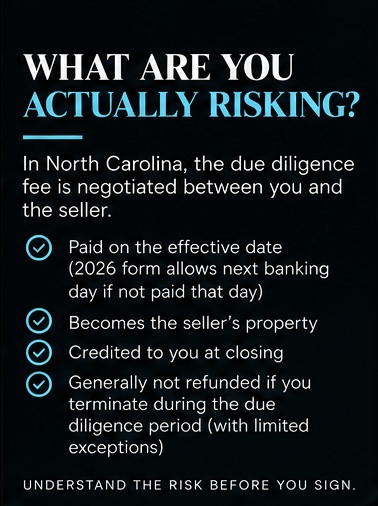
Under the commonly used NC REALTORS®/NC Bar Association Offer to Purchase and Contract, the Due Diligence Fee is negotiated between buyer and seller.
It compensates the seller in connection with the buyer's negotiated due diligence rights. During the Due Diligence Period, buyers can investigate matters affecting whether they want to proceed, including inspections, appraisal, financing, title, surveys and other concerns.
If the transaction closes, the Due Diligence Fee is credited to the buyer at closing.
But if a buyer exercises the contractual right to terminate during the Due Diligence Period, the seller generally keeps the Due Diligence Fee, subject to exceptions provided in the contract.
That's why I don't want buyers treating this number casually.
If losing that amount would financially devastate you, we need to talk about that before putting it in an offer.
Not afterward.
1. How Competitive Is This Particular House?
We need to distinguish between the market and this property.
Those aren't always the same thing.
I want to know:
How long has it been listed?
Has there been significant activity?
Are there known competing offers?
Has the price already been adjusted?
How does it compare with other available properties?
Does the seller appear to have leverage—or does the buyer?
A stronger Due Diligence Fee can potentially make an offer more attractive to a seller because it affects what the seller may retain if the buyer later terminates under the due diligence provision.
But that doesn't mean increasing it is automatically the best strategy.
Competitive does not have to mean reckless.
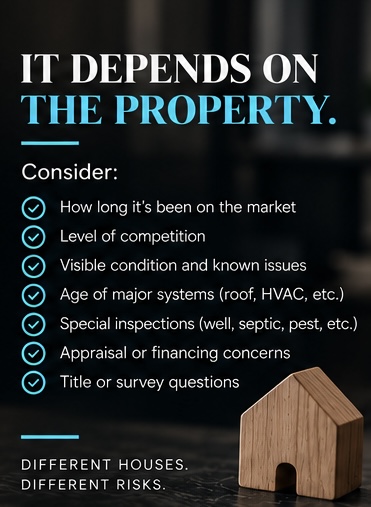 2. What Do We Already Know About the Property?
The house itself matters.
Suppose we're looking at an older property and I notice potential concerns before we even write the offer.
That doesn't automatically mean we shouldn't buy it.
But it absolutely belongs in our risk conversation.
A buyer may want to investigate things such as:
- Roof and structural condition
- HVAC, electrical and plumbing systems
- Moisture or drainage concerns
- Well or septic systems when applicable
- Pest or wood-destroying insect concerns
- Property boundaries or survey issues
- Insurance considerations
- Appraisal
- Financing
- Title
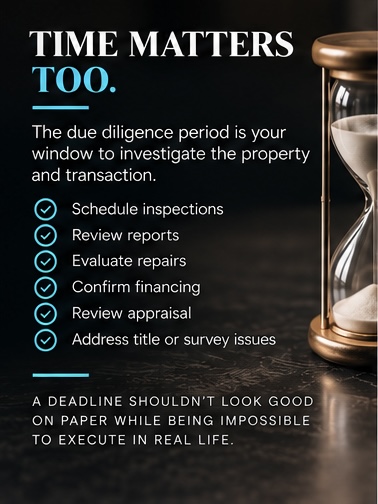
The Due Diligence Period exists in part to give buyers an opportunity to investigate the property and transaction.
So I don't want to discuss how much money we're risking independently from what we're risking it on.
 3. How Much Time Are We Giving Ourselves?
This one gets overlooked.
The Due Diligence Fee and the Due Diligence Period are different things.
The fee is money.
The period is time.
And the time can be just as important as the money.
The Due Diligence Period is negotiated, and the Real Estate Commission advises buyers to negotiate enough time to complete their investigations, including matters such as appraisal, financing and inspections.
A short period may look attractive to a seller.
But can we realistically accomplish what you need during that period?
Can we schedule the inspection?
Does the property need specialized inspections?
How quickly is your lender moving?
Are there appraisal concerns?
Are we waiting for information that could materially affect your decision?
A deadline should not look good on paper while being impossible to execute in real life.
 4. What Happens If the Inspection Finds Something Expensive?
Here's where buyers sometimes misunderstand the process.
You can ask a seller to make repairs or provide other negotiated concessions.
That doesn't mean the seller has to agree.
The NC Real Estate Commission specifically notes that repair requests are negotiable and a seller is not obligated under the standard contract simply to agree to everything a buyer requests.
Imagine discovering a significant issue.
You request a solution.
The seller says no.
Now you have a decision to make.
Proceed anyway?
Try another negotiation?
Or terminate while you still have the contractual right to do so?
That's when the amount of money you've placed at risk becomes very real.
 5. How Much Cash Will You Have Left After Closing?
This is one of my biggest concerns.
I don't want a buyer putting every available dollar into getting the house and forgetting that they're going to have to own the house.
Homeownership comes with expenses.
Things break.
Moving costs money.
You may need furniture, appliances, repairs, utility deposits or immediate maintenance.
Your mortgage approval amount does not tell me what amount of financial pressure you're personally comfortable carrying.
Neither does a competitive real estate market.
Winning the house while wiping out your financial cushion isn't automatically a win.
6. What If the Appraisal or Financing Becomes a Problem?
This deserves particular attention in North Carolina.
The standard due diligence framework allows buyers to investigate financing and appraisal during the negotiated Due Diligence Period.
That means your timeline matters.
A preapproval is important.
It is not the same thing as a final loan approval.
An appraisal can also create a new decision if the appraised value doesn't support the contract price.
This is another reason I don't evaluate the Due Diligence Fee in isolation.
We need to look at the entire transaction.
7. Ask Yourself One Uncomfortable Question
Before we submit the offer, imagine this:
You pay the Due Diligence Fee.
We conduct the inspections.
Something changes.
And after reviewing the information available to you, you decide that terminating during your Due Diligence Period is the decision you need to make.
Can you emotionally and financially accept losing that Due Diligence Fee?
If the answer is:
"Absolutely not. Losing that money would destroy me."
Then I need to know that.
That doesn't necessarily mean you can't make the offer.
It means we need to evaluate the terms differently.
But Jessica, What If Another Buyer Offers More Due Diligence Money?
They might win the house.
That's real.
There will be situations where another buyer is willing and able to assume more risk than you are.
My job isn't to pretend otherwise.
But here's something else I want buyers to understand:
You don't have to win every house.
You need to make decisions you can live with after the adrenaline of the offer is gone.
There are multiple components of an offer that may matter to a seller, including price, financing, closing timeline, Due Diligence Fee, Due Diligence Period, Earnest Money Deposit and other negotiated terms.
Our job is to understand as much as we reasonably can about the situation and build the strongest offer you're comfortable making.
Not somebody else's offer.
Yours.
Due Diligence Money vs. Earnest Money: The Part You Actually Need to Know
These aren't the same deposit.
The Due Diligence Fee generally becomes the seller's property under the contract and is credited back to the buyer at closing. If the buyer properly terminates during the Due Diligence Period, the buyer generally forfeits that fee, subject to contractual exceptions.
Earnest money is handled differently. Under the standard contract, a buyer who properly terminates during the Due Diligence Period typically receives the Earnest Money Deposit back, while failure to close after that period can put the earnest money at risk depending on the circumstances and contract terms.
That's enough terminology for this article.
The important part is understanding your financial exposure before you sign.
 A 2026 North Carolina Contract Change Buyers Should Know About
For 2026, NC REALTORS® revised Form 2-T's provisions involving delivery of the Due Diligence Fee.
The fee continues to be due on the Effective Date. However, under the revised form, if it isn't paid that day, the buyer has through the next banking day following the Effective Date to deliver it before being in breach. Additional notice and cure provisions apply before the seller may terminate for failure to timely deliver the fee.
This is precisely why buyers should rely on the current contract and transaction-specific guidance rather than old social-media posts about North Carolina real estate.
So, How Much Due Diligence Money Should You Offer?
Here's my answer:
Enough to support the offer strategy you choose—but not an amount you agreed to simply because you were afraid of losing the house.
Before recommending an offer strategy, I want to consider:
The property.
The competition.
Your timeline.
Your financing.
Your available cash.
The investigation we need to complete.
And the amount you're genuinely comfortable putting at risk.
Sometimes being aggressive makes sense.
Sometimes protecting your money matters more.
And sometimes my advice may be:
Don't buy the house.
I'd rather help you walk away from the wrong transaction than congratulate you for winning an offer you never should have made.
Buying a Home in the Triad or Burlington Area?
If you're buying in Greensboro, High Point, Winston-Salem, Burlington, Alamance County or a surrounding North Carolina community, you don't have to understand every part of the contract before you start looking.
That's part of representation.
You don't need to be ready to buy before you talk to me.
But when it is time to write an offer, I want you to understand what you're agreeing to, what you're risking and why we're choosing the strategy we're choosing.
Because getting your offer accepted matters.
Protecting your ability to make an informed decision matters too.
Jessica J. Baldovinos, REALTOR®
Certified Mentor | Real Broker, LLC
NCREL #312309
JessicaJBRealtor.net
(336) 567-5843
📍 Triad NC: Greensboro, High Point, & Winston-Salem | Including Burlington & Alamance County | Surrounding NC communities
This article is for general educational purposes and is not legal, lending, tax, inspection or financial advice. Contract terms and individual circumstances vary. Buyers should review their specific contract and consult the appropriate licensed professionals regarding questions outside a real estate broker's scope.

Categories
- All Blogs (676)
- "Did You Know?" (12)
- Best Places to Live (2)
- Buying/Selling Raw Land (48)
- Distressed/Foreclosure Education (61)
- Divorce in NC? Own Real Estate? You Should Know... (57)
- First Time Home Buyer Education (87)
- For Aspiring Agents (20)
- For NC Wholesalers (33)
- For Real Estate Agents (55)
- FSBO Tips (92)
- Holiday Moves (6)
- Homebuyer Tips (114)
- Homeowner Tips (116)
- Homesteaders (10)
- Keeping it Real (24)
- Market Forecast (22)
- Market Updates and Trends (109)
- Moving to North Carolina (7)
- My Story (3)
- NC Luxury Market Data (45)
- NC Probate (3)
- New Construction Homes (33)
- Psychology of Real Estate (6)
- Real Estate Investor Education (139)
- Sociology and Real Estate (5)
- STOP Renting! START Owning! (66)
- Win PRIZES! (1)
Recent Posts









GET MORE INFORMATION

REALTOR® NCREA CREIPS License ID: 312309