
FHA vs USDA vs VA vs Conventional Loans in NC
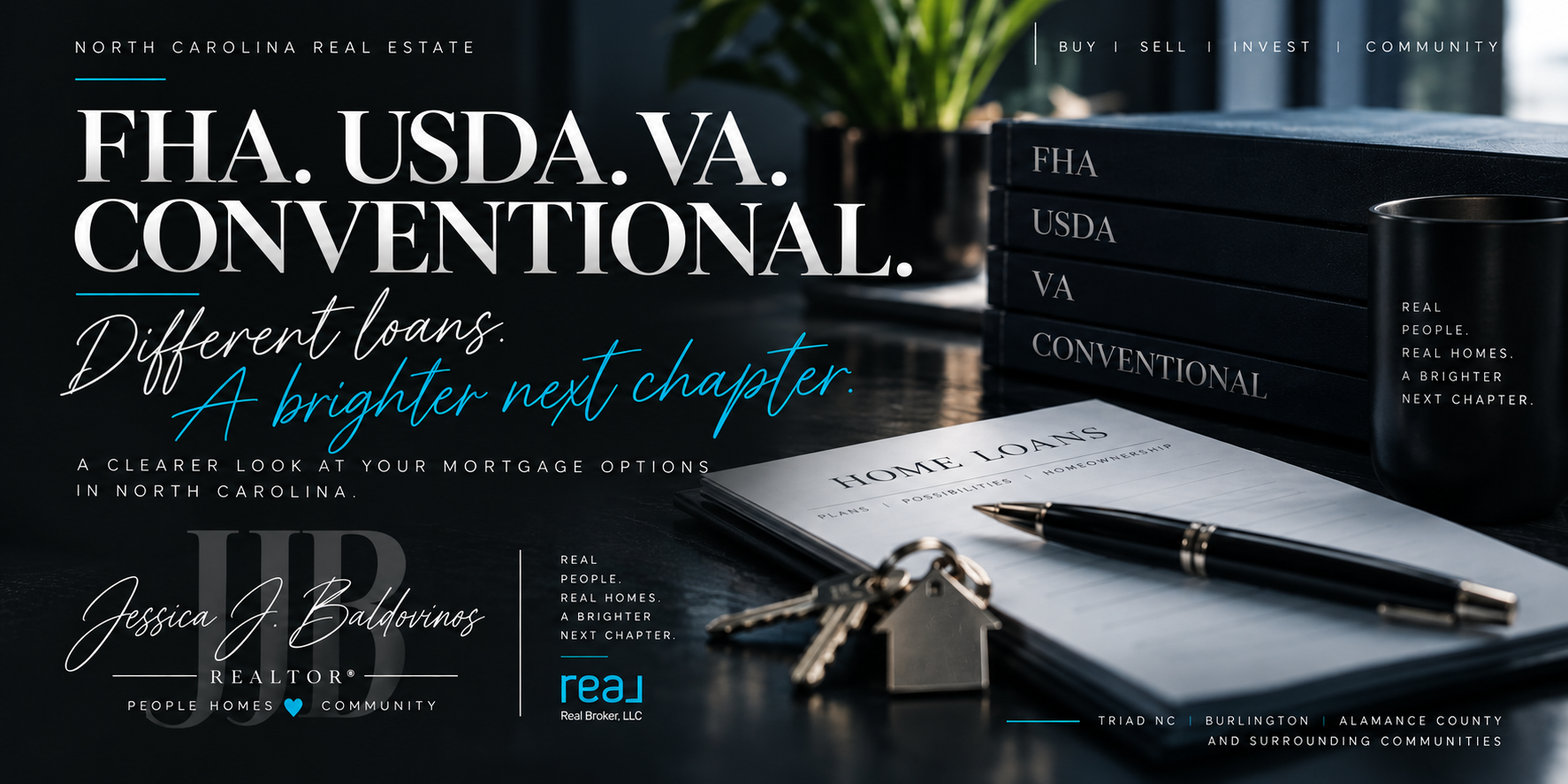 FHA vs. USDA vs. VA vs. Conventional Loans: Which Is Better for North Carolina Homebuyers?
FHA, USDA, VA, and conventional mortgages offer different paths to homeownership in North Carolina, and the best option depends on the buyer, property, finances, eligibility, and current lender requirements.
One of the first things buyers hear when they start thinking about purchasing a home is a collection of acronyms and loan names:
FHA. USDA. VA. Conventional.
Then someone inevitably says:
"You should use FHA."
Or:
"Conventional is better."
Or:
"USDA? I don't want to live on a farm."
Or an eligible veteran has been led to believe:
"Sellers don't want VA loans."
Let's clear some of that up.
There isn't one mortgage that's automatically "better."
There's the financing option that makes the most sense for your financial situation, your eligibility, the property you're purchasing, your goals, and the loan programs available to you.
And choosing financing shouldn't begin with advice from somebody's cousin, a Facebook comment, or a 30-second video.
It should begin with understanding your options.
First: What's the Difference Between FHA, USDA, VA and Conventional Financing?
These aren't simply four different names for the same mortgage.
Each program has its own structure, requirements, costs and potential advantages.
And some of the things buyers think they know about these loans simply aren't true.
Let's break them down.
 What Is an FHA Loan?
FHA loans are mortgages made by approved lenders and insured by the Federal Housing Administration (FHA).
FHA financing is often discussed with buyers because its underwriting structure can provide opportunities for borrowers who may not fit as comfortably within certain conventional guidelines.
For qualifying borrowers, FHA financing can allow a down payment as low as 3.5%, although credit, underwriting and other requirements apply.
FHA loans also involve mortgage insurance. An upfront mortgage insurance premium is generally required, and borrowers may also have an annual mortgage insurance premium collected through the monthly mortgage payment.
That doesn't make FHA financing "bad."
It simply means buyers should understand the entire cost and structure of the loan, not just the down-payment percentage.
Why Might a Buyer Consider FHA Financing?
FHA may make sense for some buyers because its qualification structure can provide flexibility depending on the borrower's overall financial profile.
But the down payment isn't the only thing to compare.
A qualified mortgage professional should help you evaluate things like:
- Monthly payment
- Interest rate
- Mortgage insurance
- Cash needed at closing
- Debt-to-income considerations
- Available assets
- Credit profile
- Property requirements
- Closing costs
- Overall cost and structure of the loan
A lower down payment does not automatically mean a lower monthly payment.
And putting more money down isn't automatically the smartest use of every buyer's cash.
Context matters.
 What Is a USDA Loan?
This one creates a surprising amount of confusion.
USDA financing is designed to promote homeownership in eligible rural areas for qualifying households.
And no—you do not necessarily have to buy a farmhouse surrounded by 100 acres. 😂
The USDA Single Family Housing Guaranteed Loan Program can provide 100% financing, meaning potentially no down payment, for qualified borrowers purchasing eligible properties.
However, both the buyer and the property must qualify.
USDA eligibility includes household income requirements, occupancy requirements and geographic property eligibility.
That creates an important distinction:
USDA isn't just about whether YOU qualify.
The property has to qualify too.
USDA provides an eligibility tool that lenders and consumers can use to determine whether a particular location may qualify.
That matters considerably when we're searching for homes.
USDA Doesn't Necessarily Mean "Way Out in the Country"
This is particularly relevant here in North Carolina.
Someone may hear "rural housing program" and immediately picture an isolated property miles from everything.
That's not necessarily what USDA eligibility looks like.
Depending on the location, buyers exploring communities surrounding the Triad, Burlington, Alamance County and other areas of North Carolina may encounter properties worth checking for USDA eligibility.
But eligibility can vary property by property and location by location, so I don't want buyers assuming a house qualifies merely because it looks rural.
We check.
Why Might Someone Choose USDA?
The obvious attraction can be substantial:
Eligible borrowers may be able to purchase with no down payment.
For someone who has stable income and can afford homeownership but hasn't accumulated a large down payment, that possibility can be worth exploring.
But again:
Borrower eligibility + household income eligibility + property eligibility all matter.
That's why USDA financing can affect the home-search strategy itself.
If your financing requires an eligible property, I need to know that before we spend our weekend touring houses that don't fit your financing.
 What Is a VA Loan?
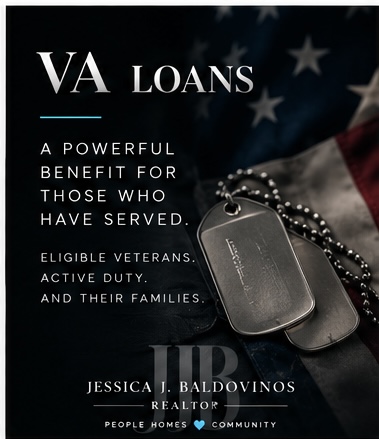
VA financing is one of the most valuable home loan benefits available to eligible veterans, active-duty service members and certain surviving spouses.
VA loans are made by private lenders, while the U.S. Department of Veterans Affairs guarantees a portion of the loan.
That VA backing allows lenders to offer qualified borrowers some significant benefits.
For eligible borrowers, one of the biggest is:
VA loans may allow 100% financing with no down payment.
VA-backed purchase loans also do not require monthly private mortgage insurance (PMI).
That combination can make VA financing an extremely powerful option for an eligible North Carolina buyer.
But—and this matters—
Having VA eligibility does not automatically mean every home or every financial situation works.
The borrower still has to qualify with the lender, and the property must satisfy applicable VA requirements.
Who May Be Eligible for a VA Loan?
VA loan eligibility is based on qualifying military service or other eligibility established by the Department of Veterans Affairs.
Depending on the circumstances, eligibility may include certain:
- Veterans
- Active-duty service members
- National Guard members
- Reserve members
- Eligible surviving spouses
The VA uses a Certificate of Eligibility (COE) to verify that a borrower meets the service requirements for the VA home loan benefit.
But there's an important distinction:
A Certificate of Eligibility isn't the same thing as a mortgage approval.
The COE establishes eligibility for the VA benefit.
The lender still evaluates factors such as income, debts, credit history and the borrower's overall ability to qualify for the mortgage.
Does a VA Loan Require Mortgage Insurance?
This is one of the important differences between VA and some other low-down-payment financing options.
VA-backed loans do not require monthly PMI.
However, many VA borrowers pay a VA funding fee.
The amount can vary depending on factors such as the type of loan, down payment and whether the borrower has previously used the VA loan benefit.
Some eligible borrowers are exempt from the funding fee.
That's another reason I don't want buyers comparing financing based on one number.
A lender should show you the entire structure.
Can You Use a VA Loan More Than Once?
Potentially, yes.
This is another misconception I hear.
Using a VA home loan benefit once does not necessarily mean you've permanently used it up.
VA entitlement rules can allow eligible borrowers to use the benefit again, and some borrowers may have remaining entitlement even while another VA-backed loan exists.
If you've used your VA benefit before, don't simply assume:
"I already used my VA loan."
Ask a VA-knowledgeable lender to evaluate your current eligibility and entitlement.
What About the VA Appraisal?
A VA-financed purchase generally requires a VA appraisal.
The VA-approved appraiser provides an opinion of value and also evaluates whether the property meets applicable Minimum Property Requirements (MPRs).
This is one reason the condition of a property can matter when we're considering homes with VA financing.
But there's another misconception worth correcting:
A VA loan does not mean the house has to be perfect.
It means there are property requirements associated with the financing.
When we're considering a particular home, we evaluate the actual property and transaction rather than automatically assuming:
"The seller won't take VA."
 What Is a Conventional Mortgage?
A conventional mortgage is generally a mortgage that isn't insured or guaranteed by a federal government agency such as FHA, USDA or VA.
And here's one of the biggest myths I hear:
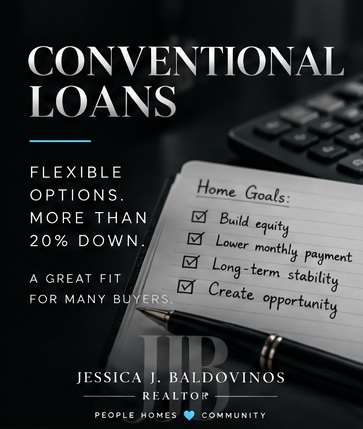
"Don't you need 20% down for conventional financing?"
Not necessarily.
Some conventional programs permit qualified borrowers to purchase with significantly less.
Certain conventional loan programs may allow eligible borrowers to purchase with as little as 3% down, depending on borrower qualifications and program requirements.
The important takeaway isn't:
"Everyone can buy conventional with 3% down."
It's:
Stop assuming conventional financing automatically requires 20%.
It doesn't.
Why Might Someone Choose Conventional Financing?
Conventional financing can offer advantages for qualified borrowers depending on the loan structure.
One difference buyers often want to understand involves mortgage insurance.
With conventional financing, private mortgage insurance (PMI) may be required when the buyer finances more than a certain percentage of the home's value.
Depending on the loan and applicable requirements, conventional mortgage insurance may eventually be eligible for cancellation as the borrower builds sufficient equity.
Again, that doesn't mean:
"Conventional is better than FHA."
It means there may be differences in monthly cost, upfront cost and long-term structure worth discussing with your lender.
FHA vs. USDA vs. VA vs. Conventional: A Simple Comparison
Here's the simplified version.
| FHA | USDA | VA | Conventional | |
|---|---|---|---|---|
| Government involvement | FHA-insured | USDA-guaranteed | VA-guaranteed | Generally not government-insured |
| Low/zero-down possibilities | Yes | Potentially 0% | Potentially 0% | Yes; some programs as low as 3% |
| Special borrower eligibility | General borrower requirements | Income/program eligibility | Military/service eligibility | Program-specific |
| Geographic restrictions | Generally no USDA-style restriction | Yes | Generally no | Generally no |
| Mortgage insurance/program fees | FHA MIP generally applies | USDA fees apply | No monthly PMI; funding fee may apply | PMI may apply |
| Property requirements | FHA requirements | USDA + geographic eligibility | VA requirements | Conventional requirements |
| Best for | Depends on buyer/property | Depends on buyer/property | Depends on buyer/property | Depends on buyer/property |
Notice what I didn't write?
"FHA is for bad credit."
"USDA is only for farms."
"VA offers are weak."
"Conventional requires 20% down."
Because those shortcuts don't accurately explain mortgage financing.
Don't Compare Mortgages Using Only the Down Payment
This is where buyers can accidentally make an expensive mistake.
Imagine being shown:
Option A: 0% down
Option B: 3% down
Option C: 3.5% down
It would be tempting to immediately declare Option A the winner.
But that's nowhere near enough information.
You also want to understand:
What will I actually pay each month?
How much cash will I need to close?
What mortgage insurance, guarantee fees or funding fees apply?
What interest rate am I being offered?
What are my closing costs?
Can the property qualify for this financing?
Are there restrictions I need to understand?
Can seller concessions be part of the transaction?
How much money will I still have after closing?
That's a much better conversation than:
"Which loan has the smallest down payment?"
 Your Loan Type Can Affect Your Home Search
This is where my role as your REALTOR® becomes particularly important.
Your lender determines which financing options you qualify for.
I don't underwrite mortgages.
But once we know your financing, I need to understand it because your loan can affect the homes we consider and how we structure your purchase.
For example, we may need to consider:
- Property eligibility
- Property condition
- Appraisal requirements
- Your available cash
- Seller concessions
- Closing timeline
- Competitive offer strategy
- Due diligence and earnest money
- Whether a particular property makes sense with your financing
Your lender and REALTOR® shouldn't be operating in two completely separate worlds.
Financing and the real estate transaction have to work together.
What About Seller-Paid Closing Costs?
Depending on the loan program, transaction structure, seller willingness and applicable lending requirements, seller concessions may help buyers with eligible closing costs.
But there are limits and requirements.
That's why I don't want buyers building a home-search budget around:
"The seller will just pay my closing costs."
Maybe.
Maybe not.
The strength of the market, the individual property and the overall offer matter too.
We build the strategy around facts first.
What About Down Payment Assistance?
Down payment assistance may also be part of the conversation for some North Carolina buyers.
Assistance programs can have their own:
- Eligibility requirements
- Income restrictions
- Property requirements
- Lender requirements
- Repayment structures
- Funding availability
- Program rules
The existence of assistance doesn't mean every buyer qualifies for every program.
It means it's worth asking the right lender:
"What programs might I qualify for?"
That's a much more useful question.
What If My Credit Isn't Perfect?
Don't automatically assume FHA is your only option.
And don't automatically assume you can't buy.
Credit is one component of mortgage underwriting, but the full financial picture matters.
If this is the part keeping you from starting, I've written an entire guide about it:
Can You Buy a House in North Carolina With Less-Than-Perfect Credit?
That guide explains what buyers should know before spending months trying to "fix" their credit without first understanding where they actually stand.
A Special Note for VA Buyers
If you're eligible for VA financing, don't automatically dismiss the benefit because you've heard sellers prefer conventional financing.
The strength of an offer involves much more than the name of the loan program at the top of a preapproval letter.
Price, due diligence, earnest money, requested concessions, appraisal considerations, closing timeline, property condition and the buyer's overall offer structure can all matter.
My job isn't to convince you to abandon a financing benefit you've earned just to make an offer look more conventional.
My job is to understand the transaction, help you understand the implications of your financing, and build the strongest strategy we reasonably can around your circumstances and the property you're trying to buy.
 FHA vs. USDA vs. VA vs. Conventional: Which One Should You Choose?
Here's my answer:
Don't choose one yet.
First, talk with a qualified mortgage lender who can evaluate your actual financial situation and eligibility.
Ask them to explain the options for which you qualify.
And if more than one program works, don't be afraid to ask:
"Can you show me what these options look like side by side?"
Look at the numbers.
Look at the monthly payment.
Look at the cash required.
Look at the interest rate.
Look at the mortgage insurance or program fees.
Look at the long-term implications.
Look at how much money you'll have left after closing.
Then make an informed decision.
And Then We Build the Real Estate Strategy
Once your financing is understood, that's when we can make your home search smarter.
We'll know what types of properties make sense.
We'll know what price range we're working within.
We'll understand potential property restrictions.
We'll know what cash you're trying to preserve.
We'll know which expenses may be coming during the transaction.
And when the right house appears, we can discuss how to structure an offer around your actual situation instead of guessing.
That's the part I care about.
I don't want you simply approved to buy a house.
I want you to understand what you're doing when you buy one.
Buying a Home in the Triad or Burlington, NC?
If you're considering buying in:
Greensboro • High Point • Winston-Salem • Burlington • Alamance County • or surrounding North Carolina communities
you don't have to know which mortgage you need before you contact me.
You don't even have to be ready to buy today.
We can start by figuring out where you are, what you need to learn, and who needs to be involved next.
Sometimes the next step is touring homes.
Sometimes it's talking to a lender.
Sometimes it's spending a few months preparing.
And sometimes my advice may be:
Don't buy the house.
The goal isn't simply getting you to closing.
It's helping you make a decision you understand.
 Let's Figure Out Your Starting Point
📍 Triad NC: Greensboro, High Point, & Winston-Salem | Including Burlington & Alamance County | Surrounding NC communities
Jessica J. Baldovinos, REALTOR®
Certified Mentor | Real Broker, LLC
NCREL #312309
📲 (336) 567-5843
🌐 JessicaJBRealtor.net
@JessicaJBRealtor
Educational Disclaimer: Mortgage programs, rates, fees, underwriting standards, income limits, property requirements and borrower eligibility can change. This article provides general real estate education and is not a mortgage approval, lending quote or guarantee of eligibility. Buyers should consult a qualified mortgage professional for current program requirements and individualized financing advice.
Categories
- All Blogs (676)
- "Did You Know?" (12)
- Best Places to Live (2)
- Buying/Selling Raw Land (48)
- Distressed/Foreclosure Education (61)
- Divorce in NC? Own Real Estate? You Should Know... (57)
- First Time Home Buyer Education (87)
- For Aspiring Agents (20)
- For NC Wholesalers (33)
- For Real Estate Agents (55)
- FSBO Tips (92)
- Holiday Moves (6)
- Homebuyer Tips (114)
- Homeowner Tips (116)
- Homesteaders (10)
- Keeping it Real (24)
- Market Forecast (22)
- Market Updates and Trends (109)
- Moving to North Carolina (7)
- My Story (3)
- NC Luxury Market Data (45)
- NC Probate (3)
- New Construction Homes (33)
- Psychology of Real Estate (6)
- Real Estate Investor Education (139)
- Sociology and Real Estate (5)
- STOP Renting! START Owning! (66)
- Win PRIZES! (1)
Recent Posts






GET MORE INFORMATION

REALTOR® NCREA CREIPS License ID: 312309